Metric-Topological Semantic Mapping and Inverse Perspective Ground Plane Optimization for Autonomous Fleet Logistics in Cluttered Warehouses}
- Authors
-
-
Kanishka Bandara Senanayake
Department of Electronic and Telecommunication Engineering, University of Moratuwa, Moratuwa 10400, Sri LankaAuthor -
Dilshan Priyadarshana Jayasuriya
Department of Computer Engineering, Faculty of Engineering, University of Peradeniya, Peradeniya 20400, Sri LankaAuthor -
Nuwan Chaminda Wijesinghe
Department of Electrical and Information Engineering, Faculty of Engineering, University of Ruhuna, Galle 80000, Sri LankaAuthor
-
- Abstract
-
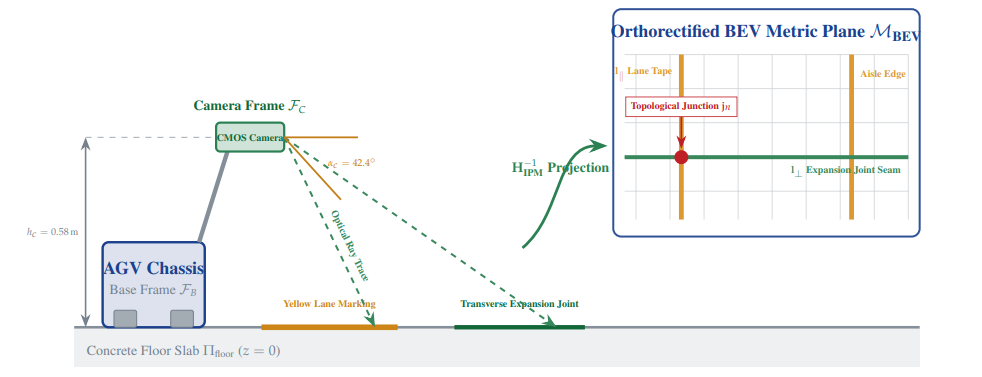
Large-scale automated fulfillment facilities and distribution hubs depend heavily on coordinated fleets of autonomous guided vehicles (AGVs) and autonomous mobile robots (AMRs). However, maintaining drift-free, centimeter-level localization across expansive warehouse corridors remains deeply challenging. Long, geometrically degenerate storage aisles cause standard planar LiDAR scan matchers to slip longitudinally, while continuous pallet shifting and human pedestrian traffic corrupt static occupancy maps. This paper presents a unified metric-topological factor graph optimization architecture tailored for multirobot intralogistics in cluttered industrial environments. The system couples 2D planar LiDAR odometry and wheel kinematics with a downward-tilted monocular vision pipeline that computes inverse perspective mapping (IPM) transformations over ground plane visual primitives, including floor lane tape, aisle crossing intersections, and structural floor expansion seams. Extracted ground line primitives and topological junction nodes are integrated directly as geometric constraints into an incremental Bayes tree factor graph. In addition, an inter-robot sparse graph reduction protocol guarantees bounded communication overhead during multi-agent loop closures across decentralized fleets. Comprehensive empirical validation was conducted across an active 24,000 m2 logistics warehouse testbed comprising four challenging operating environments. The proposed metric-topological framework achieves an average horizontal localization error of 3.42 cm and longitudinal slip suppression below 1.85 cm, outperforming state-of-the-art LiDAR-only and visual SLAM baselines by over 58%. Multi-vehicle coordination trials demonstrated deterministic solver convergence under 12.4 ms with communication payloads bounded beneath 3.8 kB/s per agent across fleets of up to fifty robots.
- Cover Image
-
- Downloads
- Published
- 2026-03-04
- Section
- Articles