Spatial-Temporal Radiation Transport Modeling in Inhomogeneous Trabecular Microarchitecture Under Radionuclide Decay
- Authors
-
-
Ahmed M. El-Sayed
Department of Mathematics and Computer Science, University of Sadat City, Sadat City 32897, EgyptAuthor -
Mahmoud K. Hassan
Department of Physics, University of Sadat City, Sadat City 32897, EgyptAuthor -
Tamer S. Mostafa
Department of Computer Science, Damanhour University, Damanhour 22511, EgyptAuthor
-
- Abstract
-
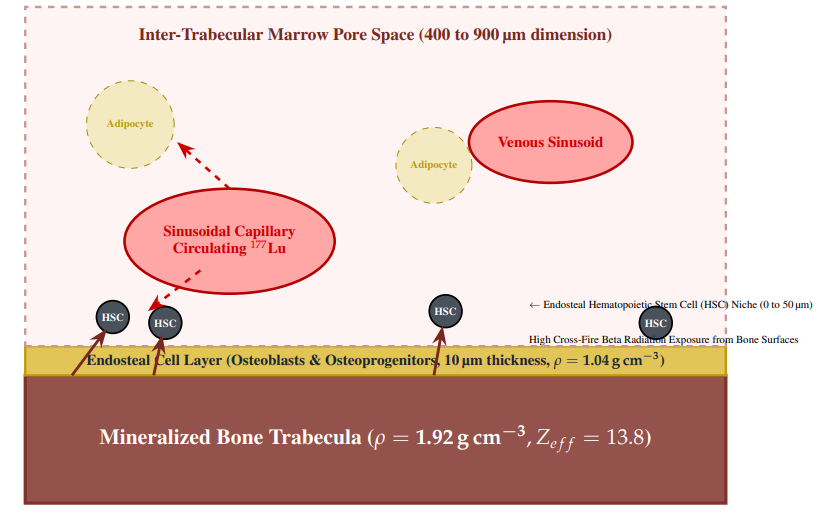
Targeted radionuclide therapy for skeletal metastases induces significant hematological toxicity due to unintended cross-fire radiation deposited within porous bone marrow cavities. Conventional nuclear medicine dosimetry relies on macroscopic, organ-averaged MIRD S-values that treat trabecular bone as an idealized homogeneous spongiosa, completely ignoring localized microdosimetric dose spikes delivered to delicate endosteal hematopoietic stem cell (HSC) niches. This investigation establishes a high-resolution spatial-temporal radiation transport framework that deterministically solves the coupled Boltzmann-Fokker-Planck transport equation across boundary-conformal unstructured tetrahedral meshes derived from synchrotron radiation micro-computed tomography (SRµCT) of human lumbar and femoral trabecular bone biopsies. We formulate a multi-group Discontinuous Galerkin Finite Element Method (DGFEM) coupled to level-symmetric Discrete Ordinates (SN) angular quadrature, incorporating continuous slowing down approximations and catastrophic Coulomb scattering operators. The deterministic solver is benchmarked against gold-standard Geant4 track-structure Monte Carlo simulations across four therapeutic radionuclides: 177Lu, 90Y, 161Tb, and 225Ac. Microdosimetric evaluations demonstrate that conventional homogeneous models underestimate localized absorbed radiation doses delivered to the endosteal stem cell layer (0–10 µm from bone surfaces) by 78% for 177Lu (78.4 mGy MBq−1 h −1 vs 38.5 mGy MBq−1 h −1 MIRD baseline) and by 136% for 161Tb (104.2 mGy MBq−1 h −1), while overestimating doses delivered to differentiated central marrow compartments by up to 42%. Integrating these microdosimetric fields into radiobiological cell-survival and Relative Seriality NTCP models reveals that endosteal stem cell survival drops to 74.2% in healthy dense trabecular bone, elevating predicted Grade ≥ 3 myelosuppression incidence from 4.2% to 16.8%. The deterministic solver executes in 4.42 minutes on GPU architectures—more than 110 times faster than Monte Carlo tracking—providing real-time computational feasibility for personalized theranostic treatment planning and skeletal toxicity risk stratification.
- Cover Image
-
- Downloads
- Published
- 2025-09-04
- Section
- Articles